

When judging conformation, sometimes the top horse will be the most obvious, but if not, I may reverse the process and start with identifying which horse in the class shows the least positives. That was the case with this class of young reining mares. The first and second-place mares were more difficult to separate than the second and third-place pair, so I determined my third-place horse first. Then I looked carefully at my top two and applied the judging criteria of balance, structural correctness, breed and sex characteristics, and muscling.
The first and second-place mares are alike in many positive traits, but also enough different that the first-place mare became clear. Her balance and structure are just a bit better than the second-place mare, and since they are mares, I considered how feminine they appear, which falls under the breed and sex characteristics category. Among the considerations for judges of conformation is preserving breed type, so I select horses that come closest to that ideal.
The Placings
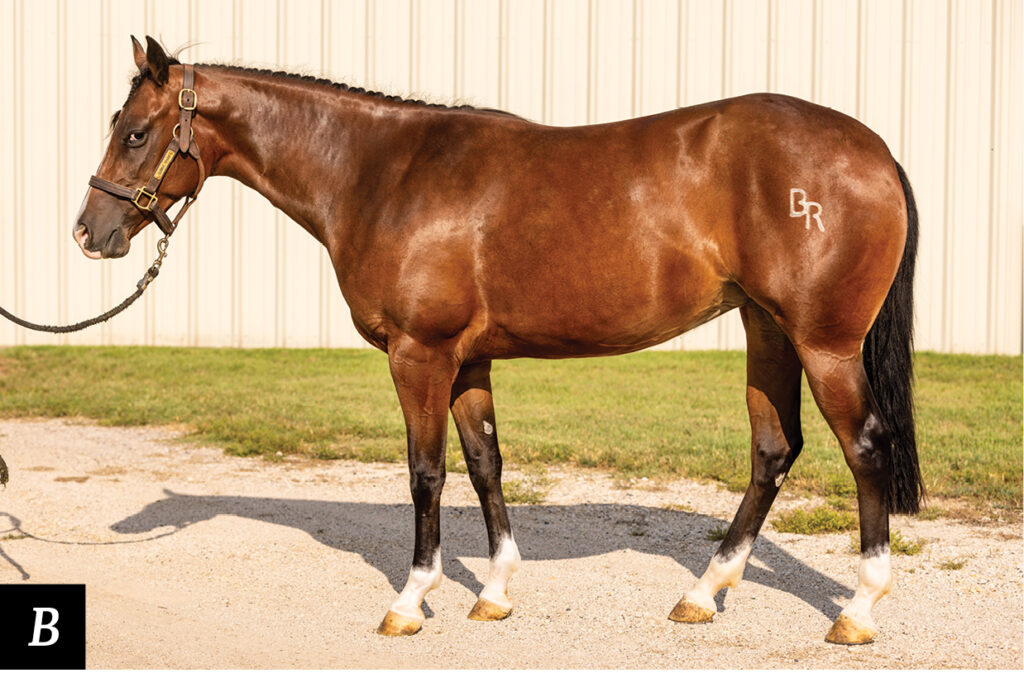
🥇 Mare B
My first impression of this bay mare is that she’s well balanced and athletic looking. She is level and can be divided into even thirds from front to back. Her topline is strong with her withers well placed and her back of proportionate length. Though she’s a little steeper in her croup than ideal, it’s minor, and her tailset is good.
Her feminine head is attractive and her throatlatch is clean. Her neck is of appropriate length, and ties in nicely at the top of her chest and at her withers. She has good slope to her shoulder which will help provide a reaching stride. Her depth of heartgirth and substance of her hip are both good for a 2-year-old, with adequate volume of muscling throughout.
Her clean front legs appear straight through the knees with good slope to her pasterns matching the slope of her shoulders. Her hind legs show an excellent set to her hocks, with her hind cannon bone forming a plumb line to the ground. She’s also near ideal with her hocks close to level with her knees.
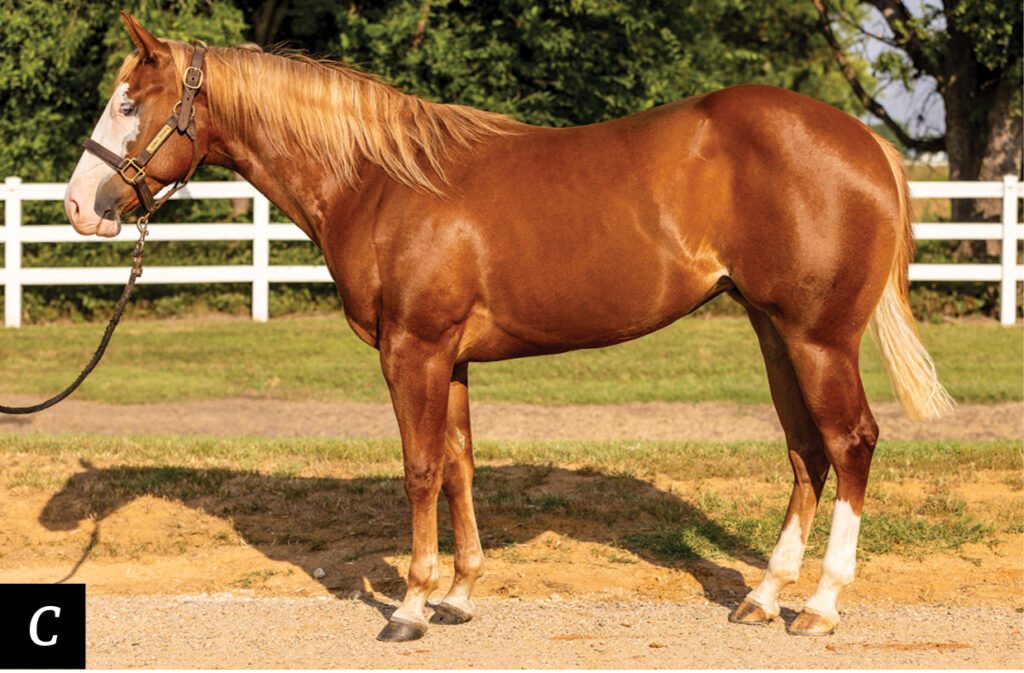
🥈 Mare C
This sorrel is attractive, but lacks the balance of the bay mare. Her withers are well set, but could be a touch farther back, and her back could be slightly shorter. She’s also higher in her hip than at her withers, but has the best carryover to her long, powerful croup, a desirable trait for reining.
Her head is less refined with a smaller eye than the bay’s, which comes into consideration with mares. Her throatlatch is nice, and her neck is proportionate in length. Her neck ties in a bit low to her chest, though, and her shoulder is a bit more upright than the bay’s. She’s deep enough through the heartgirth for her age and shows good muscle volume and definition.
Her front legs are clean with pasterns more appropriately sloped than her shoulders. Her hocks sit higher than her knees, which relates to her unlevel topline. Her hocks also show quite a bit of angle, which I don’t mind unless she’s cow-hocked, too, which we can’t tell from the side, so I’ll give her the benefit of the doubt.
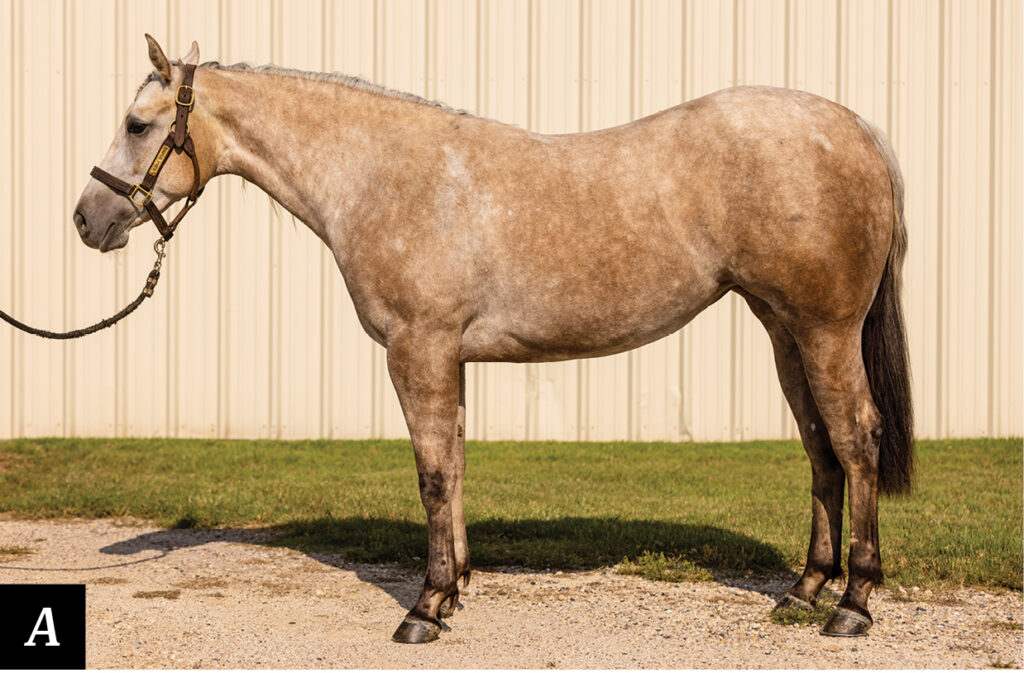
🥉 Mare A
This good-sized, pretty-colored mare is the least balanced in this class. When divided into thirds, she’s long in the middle, and she’s higher in her hip than at her withers. Her withers are also too far forward, which contributes to her long back and overall weakness in her topline all the way through her loin. Her croup and tailset by themselves are adequate.
Her head is slightly long, but not unattractive. Her throatlatch could be more refined, and her neck ties in too low on the bottom and too high on the top. This correlates to her withers being too far forward and her shoulder being quite steep. Her depth of heartgirth is adequate, but she is the smoothest and lightest muscled in this class.
Her front legs are appropriately straight through the knees, but her pasterns match her upright shoulder angle, which contributes to a less comfortable ride. Her hocks sit higher than her knees and are considerably too straight, lacking the angle needed to easily reach forward and drive herself off her hind end. She’ll have to work harder to do her job.
Marvin Kapushion operates Kapushion Training in Whitewater, Colorado, with his wife, Sue. They offer all-around training from reining horses to pleasure horses and everything in between. As a judge, he holds cards with the AQHA, APHA, ApHC, and NSBA, and has judged many major events in the U.S. as well as internationally.
To submit a photo of your horse to be evaluated in Conformation Clinic, send us a left-side profile photo of your horse (for digital photos: high-resolution, 300 dpi, in at least 3″ x 5″) to [email protected] with your contact info and your horse’s breed, age, gender, and height. (We welcome all breeds!)
How to Take a Good Conformation Clinic Photo
—H&R—